 By Caleb Morgan
Updated November 2026
An inverter for car camping turns your vehicle’s 12-volt battery power into standard 120-volt household AC, so you can run a laptop, phone charger, CPAP machine, small fan or portable fridge at a campsite. The right unit depends on how much you plan to run at once, how long you expect to be off the grid, and whether you want to plug in by cigarette lighter or hardwire to the battery. The six models below were compared on continuous wattage, peak or surge rating, outlet and USB count, display and safety features, and the patterns owners tend to report.
Our top picks at a glance
- 1
 TOP CHOICEBest overallLCD Display, Dual AC and 20A Outlets, 23ft Remote, Hardwire Port Power InverterView on Amazon
- 2
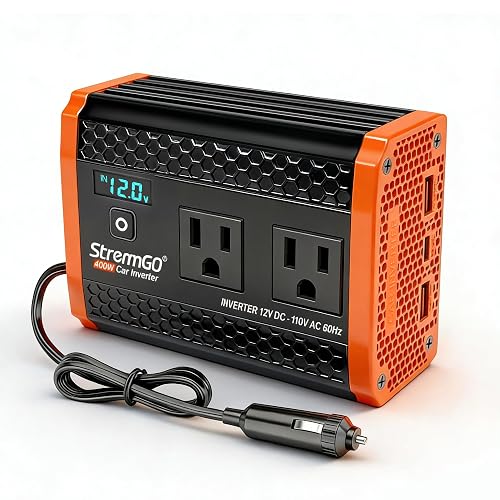 TOP CHOICEBest for light chargingUSB 24W/30W Fast Charge Cigarette Lighter Inverter 400WView on Amazon
- 3
 TOP CHOICEBest for mid-size loadsInverter 12v to 110v with Fast Charging 2.4A, Power Converter Car for Road TripsView on Amazon
- 4
 Best for multiple devices1000W Car Power Inverter, 2 Cigarette Lighter Ports, 3 AC OutputsView on Amazon
- 5
 Best budget pickCar 1000W Inverter 12V DC to 110V AC Power Inverters for VehiclesView on Amazon
- 6
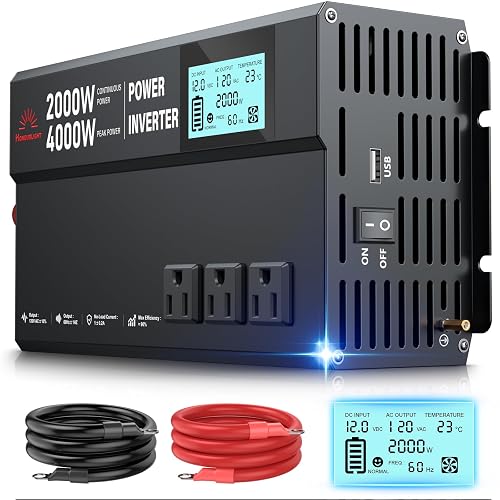 Best for off-grid backupCar Inverter 3 AC Outlets 2000W Power Inverter 12V to 110V/120VView on Amazon
Our Top Picks
Quick Comparison
| Product | Best for | Key feature |
|---|---|---|
| LCD Display 2000W Pure Sine Wave Inverter (B0DCJPTVMW) | Overall use, fridges and power tools | Hardwire port and remote |
| 400W Fast Charge Cigarette Lighter Inverter (B0G25B9S5B) | Light charging | USB fast charge |
| 1200W Peak Power Inverter (B0GVHGJ418) | Mid-size loads | Three AC outlets plus USB and Type-C |
| 1000W Car Power Inverter (B0HHLX4QB1) | Multiple devices | Three AC outputs and USB-C PD |
| Car 1000W Inverter 12V to 110V (B082V5TC11) | Budget setups | Dual AC outlets and Type-C |
| 2000W Power Inverter 12V to 110V/120V (B0HBQL2QSN) | Off-grid backup | LCD display and 4000W peak rating |
LCD Display, Dual AC and 20A Outlets, 23ft Remote, Hardwire Port Power Inverter
LCD Display, Dual AC and 20A Outlets, 23ft Remote, Hardwire Port, USB, Power Inverter for Solar, RV Truck, 93% Max Efficiency 2000W Pure Sine Wave Inverter 12V DC to 120V AC, 4000W Surge
Best for: Overall use, fridges and power tools
This is the most capable model on the list and suits campers who want to run appliances for extended periods, including a compressor fridge or a small power tool. The hardwire port lets you connect directly to the battery for a cleaner, higher-current installation.
Key specs
- 2000W continuous, 4000W surge (per listing)
- Pure sine wave output, 12V DC to 120V AC
- LCD display and 23-foot remote switch
- Dual AC and 20A outlets, plus USB ports
Pros
- Pure sine wave output is suited to sensitive electronics
- Hardwire port allows a permanent, higher-current setup
- Remote switch lets you control it from inside the vehicle
Cons
- Hardwiring requires correct cable gauge and a fuse, so installation is more involved
- Larger and heavier than plug-in models
Bottom line: Pick this if you want serious capacity and plan to run a fridge or power tools regularly.
USB 24W/30W Fast Charge Cigarette Lighter Inverter 400W
USB 24W/30W Fast Charge, Inverter 12V to110V, Cigarette Lighter Adapter for Laptop/Camping/Road Trippers 400W Power Inverters for vehicle Dual AC Car Plug Adapter Outlet
Best for: Light charging
A compact option for campers whose main needs are phones, tablets, a laptop and maybe a small fan. It plugs into a standard 12V socket, so no installation is required.
Key specs
- 400W rated output (per listing)
- 12V to 110V conversion
- USB fast charging at 24W and 30W
- Dual AC outlets
Pros
- Simple plug-in setup with no tools
- Fast USB charging for phones and tablets
- Small enough to store in a door pocket or glovebox
Cons
- 400W limit rules out most fridges and larger appliances
- Cigarette lighter sockets often have lower current limits, so avoid heavy loads
Bottom line: A good fit for weekend campers who mainly need device charging and light power.
Inverter 12v to 110v with Fast Charging 2.4A, Power Converter Car for Road Trips
Inverter 12v to 110v with Fast Charging 2.4A, Power Converter Car for Road Trips, Camping, Rv, Truck, and Camping Power Needs 1200W Peak Power Inverter, Car Inverter with 3 USB、Type-c and 3 AC Outlets
Best for: Mid-size loads
A middle-range model for campers who want to run a laptop, a CPAP-style device or a small appliance alongside device charging, without stepping up to a high-wattage unit.
Key specs
- 1200W peak power (per listing)
- Three AC outlets
- USB and Type-C charging ports
- 12V to 110V conversion
Pros
- Three AC outlets cover several devices at once
- Mix of USB and Type-C ports keeps phones and tablets charged
- Wide enough use case for road trips and RV-style camping
Cons
- Peak rating is not the same as continuous output, so check your device’s running watts
- Owners sometimes report fan noise under sustained load
Bottom line: A balanced choice if you want more outlets than a basic plug-in unit without the size of a hardwired system.
1000W Car Power Inverter, 2 Cigarette Lighter Ports, 3 AC Outputs
1000W Power Inverter 12V to 110V/120V,Power Inverters for Vehicles | 1000W Car Power Inverter, 2 Cigarette Lighter Ports, 3 AC Outputs, 2 USB-A 24W, 1 USB-C PD 30W, Flameproof, LED Display
Best for: Multiple devices
Suited to campers running several electronics at the same time, such as a laptop, camera batteries, lights and a phone, from a single unit with a clear LED readout.
Key specs
- 1000W power rating (per listing)
- Two cigarette lighter ports and three AC outputs
- Two USB-A 24W ports and one USB-C PD 30W port
- LED display and flameproof housing (per listing)
Pros
- Good mix of AC and USB-C PD charging
- LED display shows output status at a glance
- Multiple cigarette lighter ports add flexibility
Cons
- Plug-in use still depends on your vehicle’s socket capacity
- Not sized for high-draw appliances like a full-size fridge
Bottom line: Pick this for a camp setup with many small devices and a need for fast USB-C charging.
Car 1000W Inverter 12V DC to 110V AC Power Inverters for Vehicles
Car 1000W Inverter 12V DC to 110V AC Power Inverters for Vehicles Portable Vehicle Charger for Trucks, Dual AC Outlets 3.0A USB and Type-C, 12 Volt Inverter Car Cigarette Lighter Battery
Best for: Budget setups
A budget-minded option for campers who need basic AC power for a laptop, lights or a small fan and want to keep the setup simple.
Key specs
- 1000W rated output (per listing)
- 12V DC to 110V AC conversion
- Dual AC outlets
- 3.0A USB and Type-C ports
Pros
- Straightforward feature set for basic needs
- Dual AC outlets with USB and Type-C charging
- Fits common vehicle setups without modification
Cons
- Fewer outlets and a simpler display than premium models
- Owners often recommend a heavier-gauge cable for higher loads
Bottom line: A sensible starter inverter for campers who want power without paying for extra features.
Car Inverter 3 AC Outlets 2000W Power Inverter 12V to 110V/120V
Car Inverter,3 AC Outlets, 3.4A USB Port,LCD Display, Power Converter for Vehicle, Truck, Camping,Emergency Backup Off Grid 2000W Power Inverter 12V to 110V/120V AC, 4000W Peak for RV Truck Home Use
Best for: Off-grid backup
Designed for emergency backup and extended off-grid use, with a larger rated output and an LCD display for monitoring.
Key specs
- 2000W rated, 4000W peak (per listing)
- Three AC outlets
- 3.4A USB port
- LCD display
Pros
- Higher wattage handles more demanding loads
- LCD display helps track input and output
- Useful for emergency backup as well as camping
Cons
- Requires a heavy-gauge cable and a battery that can supply the draw
- Larger and heavier to store than small plug-in units
Bottom line: Choose this if you need higher wattage for off-grid days or backup power at home.
Buying Guide
Continuous Wattage Versus Peak Wattage
Continuous wattage is what the inverter can supply over time, and peak or surge wattage is the short burst it can handle when a motor starts. Add up the running watts of everything you plan to use together, then choose a unit with a continuous rating above that total, leaving some margin.
Good picks for this: 2000W Power Inverter 12V to 110V/120V and LCD Display Dual AC Power Inverter
Waveform: Pure Sine Versus Modified Sine
Pure sine wave output closely matches household power and is generally better for laptops, medical devices and other sensitive electronics. Modified sine wave units cost less but can cause buzzing or overheating in some devices. Check the listing for the waveform type before buying.
Good picks for this: LCD Display Dual AC and 20A Outlets Power Inverter
Outlets and USB Ports
Count how many devices you need to plug in at once. Three AC outlets plus USB-C Power Delivery is a practical mix for most camp setups, because phones and tablets charge faster over USB-C than over basic USB-A.
Good picks for this: 1000W Car Power Inverter and Inverter 12v to 110v with Fast Charging 2.4A
Connection Method: Plug-In or Hardwired
Plug-in inverters use the vehicle’s 12V socket and are fine for small loads. Higher-wattage units often draw more current than a cigarette lighter socket can safely carry, so a hardwired connection to the battery with a proper fuse is the better choice for sustained use. Hardwiring is best left to someone comfortable with automotive wiring, and a qualified installer can help if you are unsure.
Good picks for this: LCD Display Dual AC and 20A Outlets Power Inverter and 2000W Power Inverter 12V to 110V/120V
Battery Capacity and Vehicle Charging
An inverter draws from your starting battery, and running heavy loads with the engine off can drain it quickly. Keep the engine running during heavy use or use a dedicated auxiliary battery. Inverters also lose efficiency during conversion, so a unit rated at 93% efficiency still wastes some power as heat.
Good picks for this: 2000W Power Inverter 12V to 110V/120V and 1200W Peak Power Inverter
Size, Weight and Storage
Compact plug-in units fit in a glovebox or door pocket. Hardwired and higher-wattage models are bulkier and usually mount under a seat or in a cargo area. Measure the space you have before you buy, and make sure the unit can be secured so it does not slide during driving.
Good picks for this: 400W USB Fast Charge Inverter and Car 1000W Inverter 12V to 110V
Safety Features and Build Quality
Look for overload protection, over-temperature shutdown, low-voltage alarms and a flameproof housing. Owners often recommend keeping the unit ventilated, away from bedding and out of direct sun, and turning it off when not in use to avoid parasitic battery drain.
Good picks for this: 1000W Car Power Inverter and LCD Display Dual AC and 20A Outlets Power Inverter
FAQ
What size inverter do I need for car camping?
Add up the running watts of the devices you plan to use together and choose a continuous rating above that total. A laptop and phone chargers need only a few hundred watts, while a compressor fridge or power tool needs considerably more. Check each device’s label or manual for its wattage. A related read: Car Camping North Cascades: 5 Best Guides for Planning Your Trip.
Can I run a fridge with a car inverter?
Many compressor fridges can run from a higher-wattage inverter, but the startup surge and ongoing draw both matter. A dedicated battery and a proper hardwired connection are usually needed for overnight use. Consult the fridge manufacturer and a qualified installer before relying on this setup.
Will an inverter drain my car battery?
Yes, if you run it for long periods with the engine off. Keep the engine running during heavy use or use a separate auxiliary battery. Turning the inverter off when it is not needed also prevents slow drain.
Is a pure sine wave inverter better than a modified sine wave?
For laptops, medical equipment and other sensitive electronics, pure sine wave output is generally the safer choice because it closely matches household power. Modified sine wave units can work for simple devices like lights and chargers, but may cause issues with some electronics.
Can I plug an inverter into a cigarette lighter socket?
Small units rated for plug-in use can run from a 12V socket, but cigarette lighter circuits have limited current. Avoid running high-wattage devices through them, and check your vehicle’s fuse rating before adding any load.
How long can I run an inverter on a battery?
It depends on battery capacity and the load. As a rough method, divide your battery’s amp-hour rating by the inverter’s amp draw, then reduce the result to account for conversion losses. Real-world run time is usually shorter than the simple calculation suggests.
Conclusion
For most car campers, the best inverter for car camping is the one whose continuous wattage, outlet count and connection method match the devices you plan to run. The LCD Display 2000W model is the most capable choice for fridges and power tools, while the 400W fast-charge unit covers phones and laptops with no installation. Mid-range and multi-outlet models suit campers running several small devices, and the budget and off-grid options fill the gaps in between. Before buying, total your running watts, check the waveform type and confirm your vehicle’s wiring can handle the load.
Sources
- Guidance on energy use, power conversion efficiency and safe home and vehicle electrical practices (energy.gov)
- Consumer product safety information on electrical devices, battery safety and recall notices (cpsc.gov)
- Fire safety standards and guidance on safe use of electrical equipment and batteries (nfpa.org)
Related reading
- 7 Best Car Inverters for Camping Picks Compared for 2026
- Yosemite National Park Car Camping: A Step-by-Step Guide for 2026
- Yosemite Car Camping Reservations: A Step-by-Step Guide for 2026
- Winter Car Camping Tips: 9 Steps to Stay Warm and Safe
- Window Coverings for Car Camping: A Step-by-Step Guide to Privacy and Shade
- Why Is Car Camping Not Allowed? Common Reasons and What to Do
About Caleb Morgan
Caleb Morgan is part of our editorial team and reviews and edits our camping know-how guides, checking product details against manufacturer specifications and owner feedback.